Nick BeakeEurope correspondent

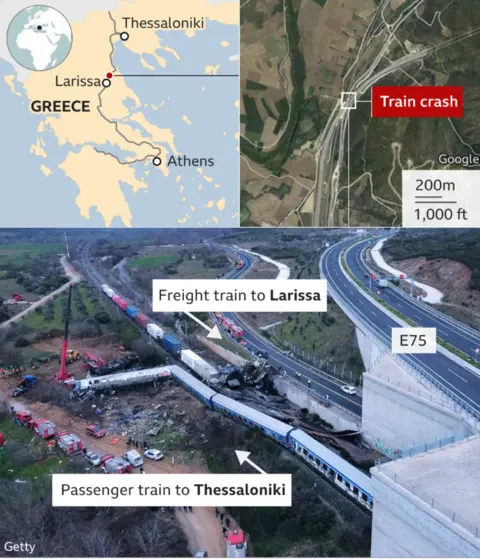
 Getty Images
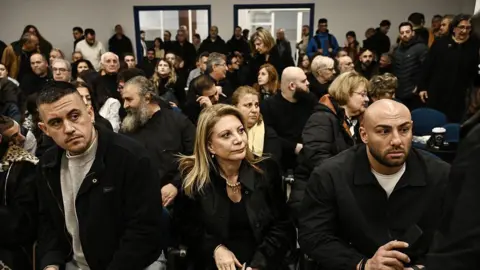
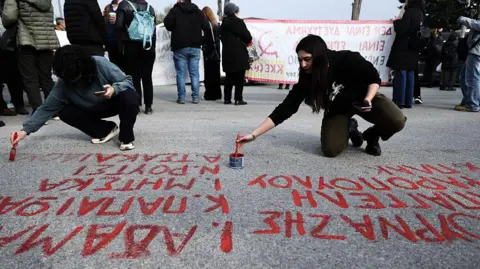
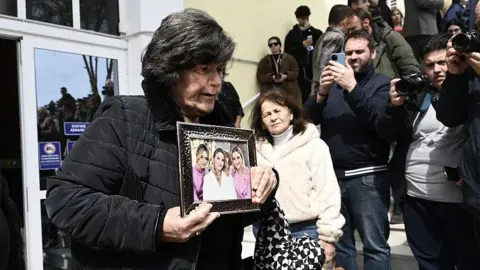
Relatives of the 57 people who died in Greece's worst ever train disaster crowded into a courtroom on Wednesday, demanding justice for the victims.
The trial had already been postponed once because of the chaotic start last week.
Some of the victims are thought to have burnt to death after surviving the initial collision.
Many relatives were unable to get into the courtroom in the central town of Larisa last week, and the situation was little different when it resumed on Wednesday.
Police officers allowed in only participants who were legally scheduled to attend.
Some relatives complained that two rows of seats had been taken up by police, while others said they still could not witness proceedings clearly enough.
Defence lawyer Zoe Konstantopoulou appealed for the proceedings to be filmed as access for families had been restricted.
The February 2023 disaster is widely known in Greece as the "Tempi crime" - with many arguing it encapsulates negligence and corruption at the heart of the state.
Thirty-six people are on trial in a case that is expected to hear from 350 witnesses and set to last years.
She, like so many other victims, was travelling back to lectures in the northern city after spending a public holiday with her family.
In the weeks after the crash, her grieving father Dimitris told the BBC he would always be proud of his daughter who "only had love to give".
He said: "We relatives call it a state assassination of our children, and all the people who were aboard that train… in which European country could this be possible?"
Anastasia had been travelling with her 20-year-old twin cousins, Thomi and Chrysa, who were also killed.
 Getty Images
Thirty-three of the defendants face up to life in prison if convicted.
Among those in the dock is a station master who failed - along with everyone else - to spot that the two trains had been travelling towards each other on the same line for 10 minutes.
Other railway officials are also on trial along with two Italian former employees of the trains' parent company, Ferrovie dello Stato.
The railway network had not made use of EU funding intended to improve safety. The head of the European Public Prosecutor's Office, Laura Kovesi, later said the collision could have been avoided if the money had been spent on modernising the signalling system in time.
Trade unions in Greece had warned that some sort of catastrophe on the railway network was waiting to happen.
To the amazement of some, the crash site was bulldozed within days, which experts say destroyed potentially crucial evidence.
This fuelled claims of a cover-up, which authorities have denied.
Mitsotakis apologised to the families of the victims in the days after the crash and has asked repeatedly for public patience so that justice can take its course.
 Getty Images
To the frustration of many campaigners, no politician is among those on trial.
The case is taking place in a remodelled conference hall that cost hundreds of thousands of euros and Mitsotakis has said it is "among the most functional and modern in Europe".
More than 60,000 pages on evidence is to be presented and 200 lawyers are involved in the case, but proceedings descended into chaos on 23 March when the courtroom became overcrowded.
Survivors of the disaster and family members of the deceased were forced to sit in the seats of the accused, most of whom were absent.
Lawyers argued health and safety regulations were being violated.
Maria Karystianou, who lost her 19-year-old daughter Marthi, said relatives had been "packed like sardines" and the spectacle was "an absolute disgrace".