By
Faris Tanyos
News Editor
Faris Tanyos is a news editor for CBSNews.com, where he writes and edits stories and tracks breaking news. He previously worked as a digital news producer at several local news stations up and down the West Coast.
/ CBS News
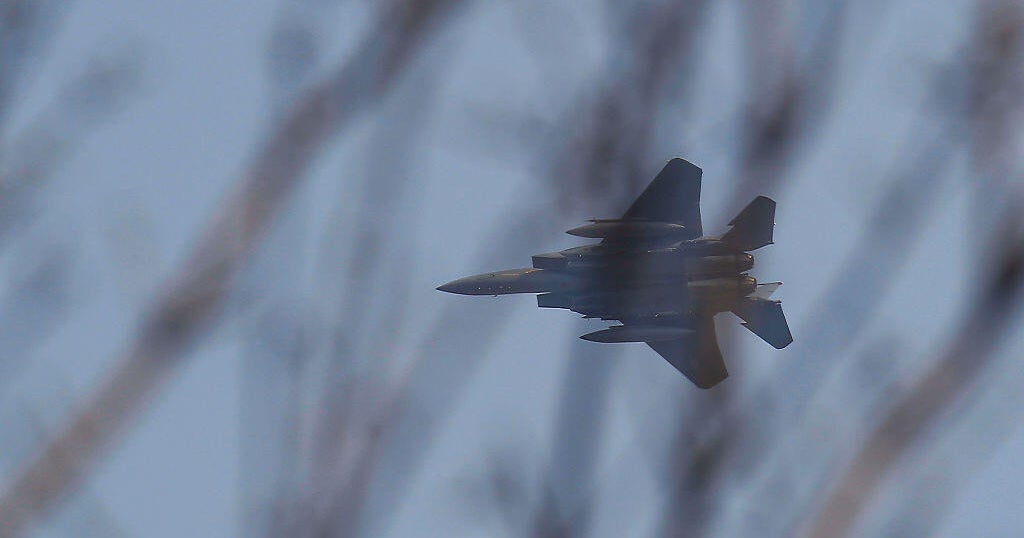
A U.S. crew member who went missing when an F-15E fighter jet was shot down over a remote area of Iran was rescued by U.S. forces early Sunday morning local time, President Trump announced. The jet's pilot was rescued Friday.
"WE GOT HIM!" Mr. Trump wrote Sunday in a Truth Social post. "My fellow Americans, over the past several hours, the United States Military pulled off one of the most daring Search and Rescue Operations in U.S. History, for one of our incredible Crew Member Officers, who also happens to be a highly respected Colonel, and who I am thrilled to let you know is now SAFE and SOUND!"
The president wrote that the service member had "sustained injuries, but he will be just fine."
Of the rescue operation, the president said that "at my direction, the U.S. Military sent dozens of aircraft, armed with the most lethal weapons in the World, to retrieve him."
U.S. officials had previously told CBS News the jet was carrying a two-person crew when it was downed by Iranian forces Friday.
Iranian Revolutionary Guards took credit for the strike, alleging the jet was brought down in southwestern Iran Friday morning. Photos of debris that Iranian media said showed the wreckage of the downed U.S. fighter jet appeared consistent with an American F-15, two weapons experts told CBS News.
The pilot of the F-15E had safely ejected and was rescued by two military helicopters, U.S. officials earlier said, but the second crew member, a weapons system officer, had remained missing.
During Friday's recovery efforts, a U.S. chopper carrying the rescued pilot was struck by small arms fire, wounding crew members on board, U.S. officials said, but the helicopter landed safely.
An A-10 Warthog that was part of Friday's search mission took fire and was damaged. The Warthog's pilot ejected over the Persian Gulf and was successfully recovered, U.S. officials said.
The downing of the F-15E fighter jet marks the first time a U.S. fighter jet has been shot down in combat in over 20 years, retired Air Force Brig. Gen. Houston Cantwell, a former F-16 fighter pilot, told The Associated Press.
At least four U.S. fighter jets have been shot down since the Iran war began on Feb. 28, but three of those were in a friendly-fire incident, the Pentagon said. On March 1, three American F-15s were "mistakenly shot down by Kuwaiti air defenses," U.S. Central Command said at the time, and there were no casualties from that incident.
CBS News national security analyst Aaron MacLean on Friday provided insight on how the search and rescue operation for the missing F-15E crew member might play out, explaining the U.S. military uses highly trained forces known as Air Force Pararescuemen who are "dedicated" for such missions.
The missing crew member would have had first-aid gear and "training in how to administer self-care in case they're injured," MacLean explained, and would be equipped with communications gear to "let their chain of command know that they are OK, and ideally participate in their own rescue."
MacLean noted that they would have a GPS tracker, a beacon and an encrypted radio that would allow them to avoid enemy personnel while signaling potential rescuers.
Until Sunday's announcement, Mr. Trump had been mostly silent on the subject of the search, telling The Independent in a phone interview Friday that he couldn't comment on what he might do if the crew member were captured by Iran.
"Well, I can't comment on it because — we hope that's not going to happen," Mr. Trump said.
In his social media post Sunday, he said the White House's silence was in order to protect the missing crew member, saying the U.S. military "did not confirm" Friday's rescue of the F-15E's pilot "because we did not want to jeopardize our second rescue operation."
Mr. Trump on Saturday also issued another warning to Iran regarding its control over the Strait of Hormuz, telling the Iranian regime it had 48 hours to reopen the crucial waterway or "all Hell will [sic] reign down on them."
Since the war began, the virtual closure of the strait — which sees about 20% of all global oil traffic — has caused fuel prices to skyrocket worldwide.
Layla Ferris and Tucker Reals contributed to this report.
In: