Pallab GhoshScience correspondent, Kennedy Space Centre, Florida

 Getty Images
In the tense final hours before Nasa's astronauts flew into space, a series of technical issues threatened to ground their landmark mission.
A faulty toilet and issues involving two safety systems were reported over radio.
Nasa managed to resolve the problems by being "quick on their feet", an official later said.
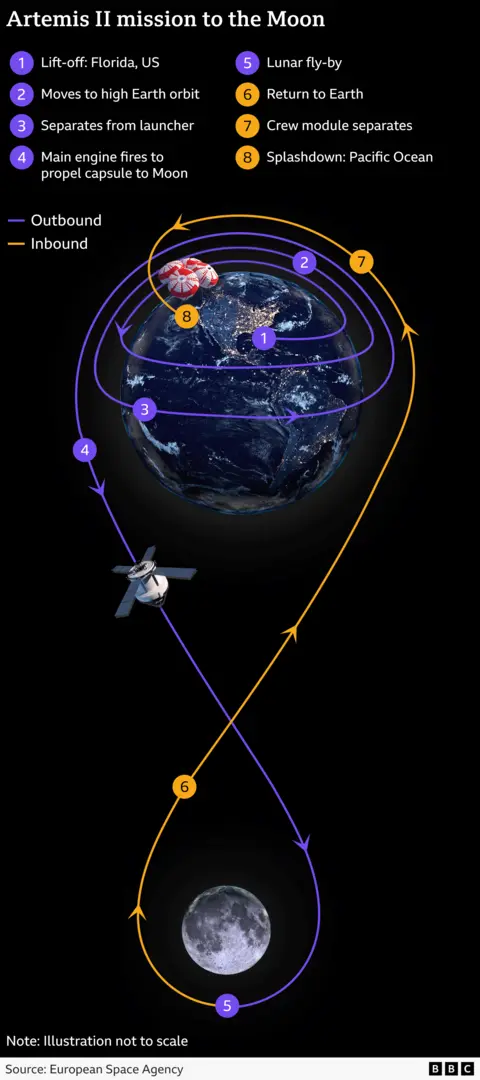
The Artemis II crew are now hurtling around the earth's orbit, carrying out final tests and checks before they head towards the moon.
Here's what nearly went wrong - and what still could.
'Toilet is go'
The crew quickly discovered that even a trip to the Moon comes with very down‑to‑earth plumbing problems.
According to flight controllers, sensors in the spacecraft's waste‑management system threw up some readings they did not expect.
Astronaut Christina Koch reportedly acted as a plumber, dismantling parts of the toilet under instruction from mission control.
"Happy to report that toilet is go for use," mission control later said over the radio. "We do recommend letting the system get to operating speed before donating fluid".
The lack of gravity in space means waste management is a key issue in space travel.
Nasa has spent more than $23m (£17.4m) developing the "Universal Waste Management System".
Both men and women are able to use the system, which includes a funnel attached to a hose to process urine while using gentle airflow to eliminate spills.
A specialised seat allows for stools to be sucked into a sealed container, with tethers and restraints being used to stop the crew from floating away.
The Orion - the spacecraft on which they're traveling - also has plenty of backup options, from alternative collection bags to different ways of routing liquids.
Issue with safety systems
There were also issues reported with the flight termination system and the launch abort system - two safety systems that protect astronauts and the public.
The flight termination system allows engineers on the ground to destroy the rocket if it veers off course. It reportedly had a communications issue, which was resolved by using hardware from the previous Space Shuttle programme.
The launch abort system is Orion's emergency escape tower, designed to pull the crew capsule away from the rocket in the event of an emergency during launch or ascent. It reportedly gave a higher-than-expected temperature reading, but it was judged that it wouldn't affect the launch.
With these issues resolved, the countdown clock was held at 10 minutes while engineers went through final preparations.
We then heard the staccato rhythm of the calls by each engineer responsible for the rocket's critical systems.
One by one the voices came back: "Booster, go", "GNC, go", "Range, go" - each reply, a tiny release of tension and a build-up of expectation.
"Artemis II, this is Launch Director – you are go for launch," the crew was told. "We go for all humanity, Commander Reid Wiseman responded.
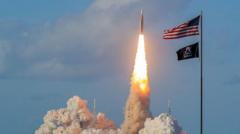
The rocket then launched into the sky, to the awe of those watching at the Kennedy Space Centre and around the world.
Trying to break spacecraft
Now safely in the earth's orbit, the crew have been directed to spend hours quietly trying to break their spacecraft - on purpose.
They cycle computers through different modes, switch radios between ground stations and relay satellites, and deliberately move around the cabin to see how the life‑support system copes as carbon dioxide and humidity build up.
Engineers also command small thruster firings and check the European‑built service module responds exactly as the models predict.
All of this is designed to answer a simple question: is the ship healthy enough to risk flying hundreds of thousands of kilometres from home with no quick way back?
If any of these tests throws up something they do not understand, Nasa will not hesitate to call off the trans-lunar injection burn and use Orion's engine to bring the astronauts straight back to earth.
Additional reporting by Esme Stallard and Tom Bennett
More on the Artemis II mission

